At the striking of noon on a certain fifth of March there occurred within a causal radius of Brandon railway-station and yet beyond the deepest pools of emptiness between the uttermost stellar systems one of those infinitesimal ripples in the creative silence of the First Cause which always occur when an exceptional stir of heightened consciousness agitates any living organism in the astronomical universe. Something passed at that moment, a wave, a motion, a vibration, too tenuous to be called magnetic, too subliminal to be called spiritual, between the soul of a particular human being who was emerging from a third-class carriage of the twelve-nineteen train from London and the divine-diabolic soul of the First Cause of all life.
Behold: one of the great opening paragraphs, from John Cowper Powys’s A Glastonbury Romance, which Colin Wilson calls in The Occult “probably unique in being the only novel written from a ‘God’s-eye’ point of view.”
“The abstractness of the language here gives a false impression of a book that is anything but abstract,” Wilson continues; “but it also reveals Powys’s desire to see his characters and events from some ‘universal’ point of view in which the algae in a stagnant pond and the grubs in a rotten tree are as important as the human characters.”
Consider Cronenberg:
It’s my conceit that perhaps some diseases perceived as diseases that destroy a well-functioning machine actually turn it into a new but still well-functioning machine with a different purpose. The AIDS virus: look at it from its point of view. Very vital, very excited, really having a good time. It’s really a triumph if you’re a virus. See the movies from the disease’s point of view. You can see why they would resist all attempts to destroy them. These are all cerebral games, but they have emotional correlatives as well.
“My movies are body-conscious,” Cronenberg insists. “The first fact of human existence is the human body. If you get away from physical reality, you’re fudging, in fantasy land, not coming to grips with what violence does.” Although the average reaction to this consciousness is one of hysterical revulsion, his films can be seen as a bloody and painful — albeit natural — conceptual process of the birth back into awareness of our relationship with our bodies. Just as scarification or piercing may re-invoke body-awareness on an individual scale, the visceral pain of Cronenberg’s imagery may exemplify what is necessary to kick-start the body-awareness of the collective consciousness.
When we talk about violence, we’re talking about the destruction of the human body, and I don’t lose sight of that. In general, my filmmaking is fairly body-oriented, because what you’re photographing is people, bodies. You can’t really photograph an abstract concept, whereas a novelist can write about that. You have to photograph something physical. So that combination of things suggests to me a particular way to deal with violence. And it’s not a bad thing that people really understand what violence is.
Indeed, Powys set out from the beginning intent on conferring his own thoughts and identity onto not only his characters but even onto inanimate objects. “I could feel myself in to the lonely identity of a pier-post, of a tree-stump, of a monolith in a stone-circle,” he writes in his Autobiography; “and when I did this, I looked like this post, this stump, this stone.”
(Powys’s mention of a post calls to mind the shape-shifting Annese of Gene Wolfe’s Fifth Head of Cerberus, described as appearing “sometimes likes a man, but sometimes like the post of a fence.”
“A fence post?” asks our narrator.
“Or a dead tree — something of the sort,” comes the reply. “Let me recollect myself. It may have been that he said: ‘Sometimes like a man, sometimes like old wood.’ No, I cannot really tell what he meant by that.”
More on Cerberus next week.)
Elsewhere in the Autobiography Powys details lecturing on Strindberg to an empty hall in San Francisco when he felt stirring in him
that formidable daimon which, as I have hinted to you before, can be reached somewhere in my nature, and which when it is reached has the Devil’s own force… I became aware, more vividly aware than I had ever been, that the secret of life consists in sharing the madness of God. By sharing the madness of God, I mean the power of rousing a peculiar exultation in yourself as you confront the Inanimate, an exultation which is really a cosmic eroticism…
And in Verona, Powys finds himself
Alone in that Roman circle, under those clouds from which no drop of rain fell, the thaumaturgic element in my nature rose to such a pitch that I felt, as I have only done once or twice since, that I really was endowed with some sort of supernatural power… I felt it again, only five years ago, when I visited Stonehenge… The feeling that comes over me at such times is one of most formidable power…
W. E. Woodward relates an odd story of Powys’s “many-mindedness” in The Gift of Life. One night after dinner at Theodore Dreiser’s house on West 57th, Powys checked his watch and realized he needed to leave at once to catch his train up the Hudson to the small town where he was living. On his way to the door, Powys turned to Dreiser and declared, “I’ll appear before you, right here, later this evening. You’ll see me.”
Dreiser laughed. “Are you going to turn yourself into a ghost, or have you a key to the door?”
“I don’t know,” answered Powys. “I may return as a spirit or in some other astral form.”
According to Dreiser, spectral apparitions had not been a part of the dinner conversation that evening, which focused instead on the much more frightening subject of American publishers. Dreiser promptly pushed Powys’s comment from his mind as another of his friend’s eccentricities and stayed up another two hours reading alone. When he looked up from his book at the end of the night, there stood Powys’s figure in the door, glowing a pale white.
“Well, you’ve kept your word, John,” Dreiser told his friend as he rose from his chair. “You’re here. Come on in and tell me how you did it.”
The apparition did not speak or move, and when Dreiser was within three feet, it simply disappeared. In his shock, Dreiser made for the phone to dial Powys’s house in the country, from where Powys picked up the phone and listened as Dreiser related his story.
“I told you I’d be there,” Powys told his friend, “and you oughtn’t to be surprised.”
Powys never explained his apparent trick to Dreiser, and in fact refused to discuss the matter at all, most probably because he himself never understood the nature of their link. “I used to be aware,” he’d later write, “of surging waves of magnetic attraction between Dreiser and myself… which seem super-chemical and due to the diffusion of some mysterious occult force…”
Perhaps it is no coincidence Powys once met his daimon while lecturing on Strindberg, who in the aftermath of his second marriage’s collapse began experiencing his own strange visions. As he details in Legends,
I was passing through a dangerous illness in the French capital, when the longing to be in the bosom of my family overcame me to such a degree that I saw the inside of my house and for a moment forgot my surroundings, having lost the consciousness of where I was. I was really there behind the piano as I appeared, and the imagination of the old lady had nothing to do with the matter. But since she understood these kind of apparitions, and knew their significance, she saw in it a precursor of death, and wrote to ask if I were ill.
“Fever” is one of Raymond Carver’s great stories where nothing much happens, or at least nothing in the text of the story. The messy divorce central to the story’s plot (such as it is) has already taken place before the narration begins. Our central character, Carlyle, is a newly-divorced teacher and father of two. Carlyle’s wife Eileen has left him for one his colleagues, with whom she now lives in Southern California. As Carlyle deals with his day-to-day life, work, and a new romantic interest, Eileen continues calling him, preaching a New Age spiel of karma and good vibes. Carver positions the reader on Carlyle’s side, joining his irritation with Eileen’s stream of unsolicited advice. As new romance begins taking root, Eileen helps him find Mrs. Webster, an ideal babysitter for the two kids. Soon after things begin to settle, the fever begins, coinciding with a piece of bad news: Mrs. Webster has decided to move to Oregon.
Carver crafts a symbolic link between Eileen and Mrs. Webster: both are associated with perfect starts, with hope, perhaps also with a sense of permanence, that things will work out. Both end up having to leave. But crucially, neither women has any ill intention toward Carlyle. His wife left him for reasons that had very little to do with him. She simply wanted to pursue her life with Hooper, to be an artist and live her New Age life in Southern California, perhaps learning about Eastern Spirituality and becoming a life coach. Mrs. Webster, similarly, has to leave for her own reasons. Mrs. Webster and Carlyle’s wife, Eileen, both are unable to give him what he needs, but that doesn’t mean they don’t care about him. The difficulty of grasping this point is what gives rise to Carlyle’s illness. In his feverish state, he tells the story of his marriage to Mrs. Webster, from the beginning to the end. He can hardly cope, and coping requires him to revise the idea of his life and his world, to let go of what is irretrievably lost. Just as his fever first arises from his inability to accept these two women leaving his life, it clears up as he finds the strength to accept his situation:
…he understood it was over, and he felt able to let her go. He was sure their life together had happened in the way he said it had. But it was something that had passed. And that passing – though it had seemed impossible and he’d fought against it – would become a part of him now, too, as surely as anything else he’d left behind.
As Strindberg neatly summarizes elsewhere in Legends: “In the great crises of life, when existence itself is threatened, the soul attains transcendent powers.”
While looking for information about Carver’s story I found this incredible comic rendition by Pitchaya Vimonthammawath. Highly recommended!
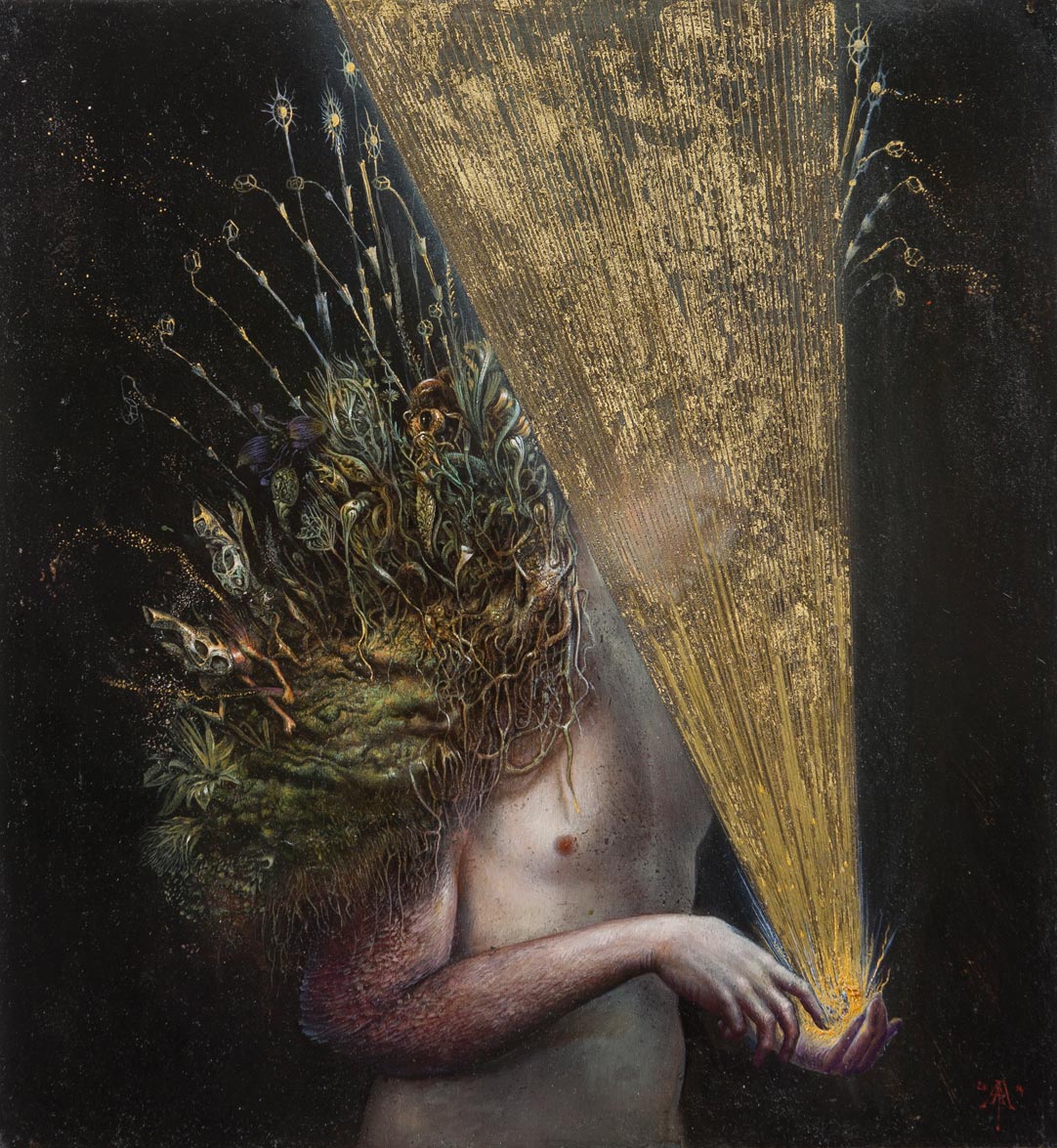
Image: Agostina Arrivabene, La pietra del filosofo, 2014



Leave a Reply