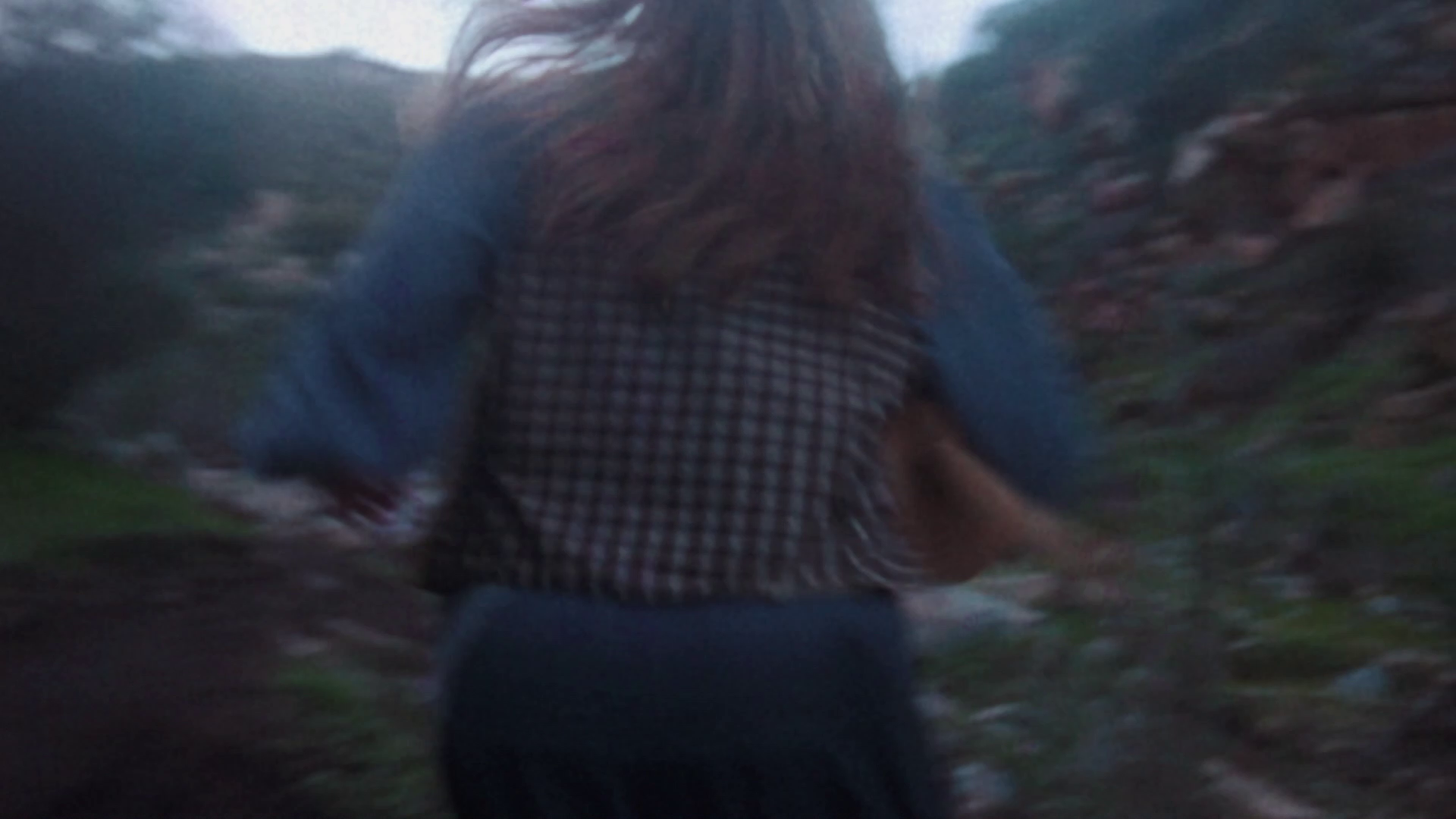
Strophische Gedichten is my new film inspired by Hadewijch of Brabant, Stan Brakhage, Anne Carson, Emily Brontë and John Ashbery, premiering March 14th at Goldsmiths College as part of Religion & Art + the subjective.
I’ll also be speaking on a panel the day before alongside Teresa Calonje, Nina Danino and Harri Hudspith about our relation to the mystics, sisterhood, affectivity and academic research, being the third person in the room in the love affair between these women and their Beloved, the question of appropriation, mediation and historical presentism and how we relate today with the mystics of the past. If you happen to be in London you can RSVP for the in-person event or join us online.
Hadewijch was a poet and mystic who lived in the Duchy of Brabant (now Antwerp) as well as a member of the Beguines, a religious movement of women who chose to live apart from society on communes to devote their lives to their faith. We know almost nothing of Hadewijch’s life save for the records she left in the form of poems and letters demonstrating a superior (and surprising) level of education, including knowledge of theological treatises in Latin and French as well as French courtly poetry, knowledge which would have been difficult for anyone to acquire in the 13th century, but particularly for a woman with no proven family ties or wealth.
But even more remarkable than Hadewijch’s education are the writings she left behind, most notably two collections of poems, the Mengeldichten (Poems in Couplets) and Strophische Gedichten (Poems in Stanzas), and a Book of Visions, the very first such collection written in vernacular language, in which she details her personal relationship with Jesus through philosophical dialogues and metaphysical voyages. Her work is characterized by an extreme (even exhaustive) notion of Love as that which informs and pervades all of life. Throughout her writing, Hadewijch relates multiple times not only her ecstatic elation at transcending to the throne of God and wedding her soul to His but also the crushing pain with which she was left when she would inevitably be forced to return to her earthly body.
Among other early women mystics, Hadewijch can be read in part as attempting to perform the substance of love. While this demonstration may not (and as will be shown cannot) ‘justify’ immanence according to other conceptual frameworks based on a prior transcendent unity, it does build a robust case precisely for questioning such conceptual traditions which have rejected the mystical accounts of medieval women.
Transcendence often works itself in a totalizing form of authority. But Hadewijch pays no attention to ecclesial authority. Unlike many other mystics Hadewijch does not reference any religious authority figure within the church. Many figures enter in as inspirational (such as Augustine) but she does not appeal to them on the basis of some conferred authority. Even with respect to the authority of God there is boldness to how she approaches this relationship. In Letter 4, Hadewijch challenges the authority of reason if it “fails to stand up to [God’s] greatness.” This neglect of priestly authority, challenge to Reason and boldness before God further points to the ongoing direct relay between her and God. As with Jacob, there are times when she must confront God or at least acknowledge the insufficiency of their relationship. Vision 7 finds Hadewijch concerned that “I did not content my Beloved, and that my Beloved did not fulfill my desire.” Hadewijch is later confirmed in her strength and boldness. At the end of Vision 14, she receives power from God which was “the strength of his own Being, to be God,” culminating in a voice which says, “O strongest of all warriors! You have conquered everything and opened the closed totality.” Power flows from God, but God’s totality is thereby opened.
It’s in this manner Hadewijch’s conception of divinity relates to Deleuze’s paradigm of immanence, one in which both the cause and effects of being belong to the same plane. There is no transcendent point of reference, for each being is co-constitutive of every other being. An immanent relation is one in which neither term can be made utterly prior to the other; immanently related terms are mutually constitutive. Immanence thus puts in play a reciprocal relay between namelessness and excessive signification.
Few artists devoted their creative lives to the pursuit of unfettered immanence as wholeheartedly as Stan Brakhage, whose essay “The Untutored Eye” perfectly outlines the paradigm of immanence:
Imagine an eye unruled by man-made laws of perspective, an eye unprejudiced by compositional logic, an eye which does not respond to the name of everything but which must know each object encountered in life through an adventure of perception. How many colors are there in a field of grass to the crawling baby unaware of “Green?” How many rainbows can light create for the untutored eye? How aware of variations in heat waves can that eye be? Imagine a world alive with incomprehensible objects and shimmering with an endless variety of movement and innumerable gradations of color. Imagine a world before the “beginning was the word.”
The most pervasive indicator Hadewijch’s work relates to Deleuze’s concept of immanence is understanding how love functions in her works. Love can be read in every word she ever wrote. Hers is a love which never settles, neither remaining at the heights of heaven nor in the depths of hell but through and beyond these places. Hadewijch never removes God from the scene to signify an unsignifiable unity; rather, God and Hadewijch and love continue to move in increasingly excessive articulation, pouring over each other as though all finally constitute one substance in an ongoing differential relation. This is seen most clearly in her poetry, in which there appears several attempts to see where love can all fit, to see if it is actually possible for all to be love. In the aptly titled “Were I but Love,” Hadewijch writes,
Beloved, if I love a beloved,
Be you, Love, my Beloved;
You gave yourself as Love for your loved one’s sake,
And thus you, Love, uplifted me, your loved one, with you!O Love, were I but love,
And could I but love you, Love, with love!
O Love, for love’s sake, grant that I,
Having become love, may know Love wholly as Love!
It is possible to render this poem to the point where the only word that remains acknowledging difference is if. For if Hadewijch were love, everything would pour over love from love to love for love as love. All that remains are prepositions pointing to the differential relation of one undifferentiated substance. Whereas Spinoza attempted to keep open the relay of univocal substance with the phrase “God, or Nature,” Hadewijch takes a different path pursuing the line of desire, if love. This path also unfolds as building up courage, getting lost in the abyss, being blinded by light, sinking into hell; all the excesses of love.
The question Hadewijch never asks, the one central to every one of her poems and recorded visions, is how to live when that love is taken from you.
Anne Carson’s “Glass Essay” is a long and unraveling portrait of a woman’s grief after love lost, which she examines while visiting her aging parents on a moor in northern Canada. Carson’s narrator takes with her “…a lot of books—”
some for my mother, some for me
including The Collected Works Of Emily Brontë.
This is my favorite author.
It was never clear what Emily herself was looking for. Such is the mystery of her strange life and her strange work. In her 1850 preface to Wuthering Heights, Emily’s sister Charlotte writes with awed fascination of her sister who, as Carson quotes, “was not a person of demonstrative character.” Even “those nearest and dearest to her” could not “with impunity, intrude unlicensed” into the recesses of her mind. Charlotte confesses a fearful respect for the secrecy of those alarming “recesses”: the deep, secret self her sister guarded so sternly. Emily is always one more locked door away from those who loved her in life and those who love her work. To get closest to her work is to accept that you will never see to the bottom of those recesses. Charlotte recognizes this, and Carson does too.
In Emily’s poetry, Carson writes, she “had a relationship… with someone she calls Thou,” who may be God or Death, or something undefined. Emily, in her apparent isolation, seems to have had a perhaps surprisingly clear understanding of how to relate to the other, even if her other is a force, not a person. It seems strange to turn for advice on love to Emily Brontë, a woman “unable to meet the eyes of strangers when she ventured out,” who according to her biographers led a “sad, stunted life… Uninteresting, unremarkable, wracked by disappointment / and despair.” Yet it is through Brontë that Carson begins to ask the same fundamental questions which Hadewijch sought to answer: how are we to look at the loved one, and how are we to look at ourselves? Weird Emily, communing intermittently with Thou, might offer an answer for how to be held closely yet at a distance, in some state of perpetual transit between the “inside outside” and the “outside inside.” “Thou and Emily influence one another in the darkness,” writes Carson, “playing near and far at once.” Something about this seeming paradox of location, near and far, inside and outside, and the way that Emily flits between the two, seems to hold some promise of escaping the mere self. Her word for this is “whaching.”
To be a whacher is not a choice.
Whaching is not simply watching; while she whached things we can all observe, like “humans” and “actual weather,” Emily also whached those things that cannot be seen or known, like “God” and “the poor core of the world.” Whaching somehow allows her to be at once inside and outside of herself; by whaching, Emily shatters “the bars of time” and seems to exist outside its prison. Apparently, whaching is less an action than a state of being.
For Carson, “whaching” is both an internal and external process, a way of seeing and also feeling, understanding, sensing, a state of being. “To be a whacher is not a choice. / There is nowhere to get away from it, / no ledge to climb up to”; this encompassing overwhelm of information and images, this impossible task of collecting, categorizing, making sense of the self from within the self and the world beyond the self and the world in relation to the self, this dizzying confusion of perspectives and the inescapability of one’s own at once limited and infinite gaze. There is no looking beyond — without, from outside of — the self. And yet looking beyond — outward, toward some external thing — the self is perhaps the closest one can get to an “emptiness [which] is not empty,” a clarity or peace, a plain being. It is only through looking, then, that “finally everything expands.”
“The Glass Essay” is a complex structure, holding two disparate elements together in a surprising balance: an intimate meditation on a romantic breakup, and a critical reading of the life of Emily Brontë. Immediately upon my first encounter with “The Glass Essay” I found myself compulsively returning to it, over and over. The urge to reread flowed out of my desire to sink further into the poem and remain there, a desire that in turn flowed out of the deeper, inane desire (Carson’s, my own) to sink further into the memory of a departed lover and remain there. On the cusp of dark and dawn, I would lie in my narrow bed and try to memorize the whole thirty-eight-page poem. I never got very far, but certain lines snagged in my mind. The moments that really cut were those where the language is plainest, most painful:
I can hear little clicks inside my dream.
Night drips its silver tap
down the back.
At 4 A.M. I wake. Thinkingof the man who
left in September.
His name was Law.
Carson titles the second section of her poem-essay “SHE,” a pronoun which in turn refers to Carson’s mother and Carson herself, as both narrator and character in the action of the poem. The self is multiplied, and might cross itself if you’re not careful. As time slides and aligns and blurs, so too does Carson’s speaker feel her present self slip into a past self of the hot last April, inhabiting simultaneously a then-“she,” trapped in memory, and a now-“I,” writing in the present.
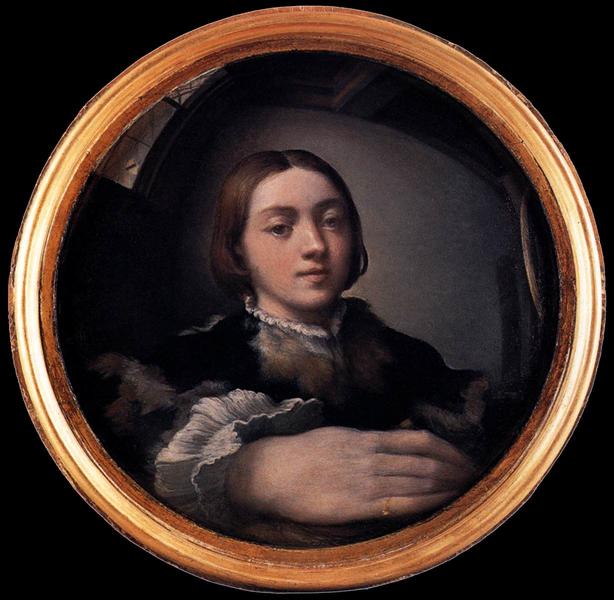
Despite the poem’s title, John Ashbery is not the subject of his “Self-Portrait in a Convex Mirror,” at least not in any straightforward sense. The poet casts himself as both the author of this meditation on Francesco Parmigianino’s 1524 Mannerist portrait, and a fascinated observer, admirer, and intimate companion of the painter, compiling his thoughts on the piece in verse some four centuries after its creation. Writing in 1972, he recreates the moment he saw the painting for the first time, thirteen years previously in Vienna’s Kunsthistorisches Museum. As we read the poem we relate to a spectator from the future, one who reimagines the encircled figure containing the painter’s face, background window, and foregrounded hand as a potential model for his own self-portrait.
Throughout his self-referential commentary, the poet shares the artistic compassion and intellectual curiosity an engaged viewer might develop in response to the painter’s image. But the impression of Parmigianino’s life captured in the rounded, rather than flat, reflective surface also stirs a suspicion of its artificiality, raising doubts about our sympathy with the past as distorted by the painter’s uniquely ordered presentation and personal history. Only by ultimately sacrificing his apparent intimacy with Parmigianino, formed through his attachment to the long-dead painter’s symbolic reconstruction of his own life, does Ashbery poignantly convey the limitations of portraiture and urge the need for a revaluation of his poetic enterprise.
The poem, then, reads as both art criticism — Ashbery notes how the painter’s “englobed” representation breaks from mimetic realism, giving the illusion of a complete self-portrait — and a critique of the artistic design’s inherent simplification of Parmigiano’s life. To draw another comparison to Brakhage, consider his 1974 film The Text of Light, in which he films objects around the house through a glass ashtray, distorting light and generating new perspectives:
In the opening lines, Ashbery declares the intactness of the curved figure renders the aesthetic object a prison-house:
One would like to stick one’s hand
Out of the globe, but its dimension,
What carries it, will not allow it.
The portrait’s symbolic unity, carefully circumscribed by its familiar arrangement of furniture and bodily parts, does not provide the musing poet with enough substance to speculate about, let alone establish a real connection with, Parmigianino’s life. So from the vantage point of a historically remote observer-poet, the artistic techniques employed to draw out and personalize the painter’s life (the lived experiences that constitute it) actually place it beyond the “reach” of sympathy, depicting nothing more than the portrait’s surface phenomena.
The soul establishes itself.
But how far can it swim out through the eyes
And still return safely to its nest? The surface
Of the mirror being convex, the distance increases
Significantly; that is, enough to make the point
That the soul is a captive, treated humanely, kept
In suspension, unable to advance much farther
Than your look as it intercepts the picture.
Just as language is doomed to convey a pure surface, so the “shadow artist” reproduced by the painting’s organizing imagery — the “visible core” of that surface — still controls its generating intents, both formally and morally speaking. The portrait’s surface allows us, for instance, to enjoy a vision of undisturbed intimacy between its parts that is unavailable in the shifting time and disordered space of ordinary existence, if only confined within its virtual reality, “wherein changes are merely / Features of the whole. The whole is stable within / Instability, a globe like ours, resting / On a pedestal of vacuum[.]” Compare Ashbery’s reading of Parmigianino to the comparison drawn earlier between Hadewijch’s undifferentiated love of/and/for God with Deleuze’s paradigm of immanence. Yet, aware of the visual distortion which makes the illusion possible, Ashbery veers towards treating Parmigianino’s image (and his soul) as something sequestered in its artifice and incapable of achieving kinship with the viewer.
The portrait’s surface thus becomes a metaphor for its literal superficiality. Bound not by the artist, but by its formal exigencies, the artwork in part deflects the personal experience that went into its execution, the artistic “interior” underlying its creation. Though Parmigianino’s “soul” visually “establishes itself” in the image of the painter, ostensibly fully formed by the mirror’s convexity, its portrayal confirms that it “is a captive” and not readily accessible to the spectator. And even if the portrait’s subject is indeed (ironically) “treated humanely,” its transmission to an audience is interrupted by its formal presentation (“kept / in suspension”) as much as it is by our observation (“your look as it intercepts the picture”).
For Ashbery, Parmigianino’s imaginary distortions keep the observer at a noticeable remove from the subject of portrayal, showing that “the distance increases / Significantly” between the painter’s illustrated face and his expired soul. In doing so, such distortions also call into question the painter’s ability to reproduce an ultimate, clear-cut account of himself, capable of sincerely communicating his personality to an individual observer. Ashbery’s metaphorical separation of the bygone artist from the present-day spectator, spelled out in terms of the portrait’s display, attests to the failure of the painter’s self-contained representation of his life. As Roland Barthes argues in his own fictionally staged autobiography, Roland Barthes par Roland Barthes: that “in the field of the subject, there is no referent,” no fixed symbol fit to essentially convey one’s identity truly as it is (or was). In his writing, Barthes exposes the limits of self-expression through a series of divagating photographs and textual references that, rather than forming a unified picture of himself, casts particular life events in multiple ways. Inversely, the speaker of “Self-Portrait” questions Parmigianino’s reductive image by noting how few and arbitrarily-chosen references to his life actually appear in it.
In her essay “John Ashbery and the Artist of the Past,” Helen Vendler argues that the moral content of Parmigianino’s painting depends on whether a “direct ethical injunction to life-action can be deduced” from the poet’s intimacy (or lack thereof) with the artist as generated by the symbolic object.
The soul has to stay where it is,
Even though restless, hearing raindrops at the pane,
The sighing of autumn leaves thrashed by the wind,
Longing to be free, outside, but it must stay
Posing in this place. It must move
As little as possible. This is what the portrait says.
The poet in fact re-presents Parmigianino’s self-portrait in language, remarking how confined within its delimiting frame, the painter’s surroundings encircle the mirrored figure and draw our attention towards “the polestar of [his] eyes which are empty[.]” But rather than revealing anything about his life, the painter’s “eyes proclaim / that everything is surface,” that beyond the representative elements contained within the self-portrait “nothing can exist except what’s there.” Inevitably, there are details that will remain peripheral to the portrait, looming alternatives which must have been forcibly abstracted from Parmigianino’s life in the impossible effort of condensing them into a summary image. By virtue of his omissions, Parmigianino’s representation only precariously “holds its mirror up to nature”; the changeless reality it depicts, confined to the contents of the painter’s studio, necessarily excludes relevant pieces of the artist’s interiority. Ashbery suggests such marginalized emotions, thoughts, and experiences pose the limits of self-knowledge built into the portrait. Without access to the full scope of the painter’s inner life, the poet confronts the prescriptive demands underlying his bereft and immobile figure.
These lines register how the illusion of a complete self-portrait deprives the painter’s “soul,” and how, in copying his stationary image through a strict set of visual features, Parmigianino structures his self-portrait according to an imperative of formal exclusion: “It must move / As little as possible. This is what the portrait says.” It is the fixed “pose” of the portrait’s subject which conveys both the pathos of an inaccessible external world (the “sighing of autumn leaves”) and a plaintive sense of the painter-figure’s “Longing to be free[.]”
Throughout the poem, Ashbery returns to this melancholic longing for wholeness lost in frustrated attempts at mimesis, often expressing the portrait’s restrictive image in contradiction:
But there is in that gaze a combination
Of tenderness, amusement and regret, so powerful
In its restraint that one cannot look for long.
The secret is too plain. The pity of it smarts,
Makes hot tears spurt: that the soul is not a soul,
Has no secret, is small, and it fits
Its hollow perfectly: its room, our moment of attention.
The tension lies partially in that the poet’s nostalgia is continuously offset by his skepticism towards his own ekphrasis — his literary commentary on Parmigianino’s artwork — which the poem interrogates as it performs. In other words, Ashbery is aware that he can only communicate how situating the painter’s “soul” implies marking its absence from the portrait, its lack of correspondence with the real, animate, and mutable Parmigianino.
And just as there are no words for the surface, that is,
No words to say what it really is, that it is not
Superficial but a visible core, then there is
No way out of the problem of pathos vs. experience.
What “Self-Portrait” poses as “the problem of pathos vs. experience,” the unbridgeable gap between an artwork’s aesthetic qualities and the artist’s real-life circumstances, translates to the poet’s impossible task of articulating a solution, that is to say, of fully accounting for Parmigianino’s life through words.
I feel the carousel starting slowly
And going faster and faster: desk, papers, books,
Photographs of friends, the window and the trees
Merging in one neutral band that surrounds
Me on all sides, everywhere I look.
And I cannot explain the action of leveling,
Why it should all boil down to one
Uniform substance, a magma of interiors.
Far from transcribing into his own work the conventions purportedly encompassing the world outside the portrait (or windowpane), the poet finds himself perplexed by the confining perspective within. In recounting his troubled attempt at understanding the painting, Ashbery disrupts the smooth import of art into poetry.
What is novel is the extreme care in rendering
The velleities of the rounded reflecting surface
(It is the first mirror portrait),
So that you could be fooled for a moment
Before you realize the reflection
Isn’t yours.
Ashbery foregrounds the ways Parmigianino’s work conceals the distinction between life as portrayed through aesthetic conventions and life independent of art. He recreates the portrait’s formal organization in words, describing ordinary, lived events (including his own reactions to the painter’s image) as products of the artwork’s design. In their syntax of logical dependence (“So that”), these lines suggest the viewer’s abrupt awareness of difference results from the artist’s method, and therefore such a contingent reaction can be explained in terms of a preconceived, human system of meaning. The speaker rationalizes the experience of being “fooled for a moment” by attributing it to the painter’s “extreme care in rendering” his own subtle intentions: “The velleities of the rounded reflecting surface.” The response is justified retroactively by Ashbery’s invocation of Sydney Freedberg’s analysis of Parmagianino’s wish thourhg the subtleties of art “to impart the sense of novelty and amazement to the spectator.”
Ashbery’s repeated qualifications assert that it is not the passive detection of the observer’s cognition but the artist’s anticipatory techniques which account for the change, since, “as Freedberg points out, / The surprise, the tension are in the concept / Rather than its realization.”
You feel then like one of those
Hoffmann characters who have been deprived
Of a reflection, except that the whole of me
Is seen to be supplanted by the strict
Otherness of the painter in his
Other room. We have surprised him
At work, but no, he has surprised us
As he works. The picture is almost finished,
The surprise almost over, as when one looks out,
Startled by a snowfall which even now is
Ending in specks and sparkles of snow.
The poet’s assignment of order to conflicting elements of experience further complicates our own awakening to the world as readers; we who like Ashbery have become absorbed in an aesthetic object through our investment in the poem.
We do not surprise the painter upon reading a written report of his work, but rather are surprised as we learn about and ourselves experience its captivating effects. Ashbery insists that our “surprise” has been contrived by the artist, noting how this renewed (and “startling”) sense of self, in our enthrallment, proceeds from having the painter’s context temporarily substituted within us for our ordinary consciousness of historical reality. Only after being immersed in Ashbery’s description of Parmigianino’s picture can we then feel ourselves extricated from our absorption in visual, and by extension, poetic art. Similarly, the poet’s disentanglement from the portrait’s representation prompts him to acknowledge that he has neglected life’s unfolding while suspended in a moment of aesthetic intimacy. “This is its negative side,” Ashbery says of the portrait, asserting that once its beautiful effect subsides, it becomes a source of loss that can be intuited only after the fact.
It may be that another life is stocked there
In recesses no one knew of; that it,
Not we, are the change; that we are in fact it
If we could get back to it, relive some of the way
It looked, turn our faces to the globe as it sets
And still be coming out all right:
Nerves normal, breath normal. Since it is a metaphor
Made to include us, we are a part of it and
Can live in it as in fact we have done
“Its positive side is,” by the same token, “Making you notice life” outside of the painting. The portrait is also the exhibit of its insufficiency and represents the muted “stresses” of Parmigianino’s contemporary moment, which, like ours, have been subsumed and silenced by his formal innovations. But if in this sense the painter’s obstructing image indeed points towards the external possibilities it suppresses, it does so ironically — as towards a life pending retrieval.
Ashbery here entertains a kind of Ich-Du relation between the life-within-the-portrait as organizing agent —”it, / Not we, are the change” — and ourselves as excluded observers, who “are in fact it.” He describes our connection with the painting by addressing Parmigianino as a person from the past, and no longer as a subject objectified by the self-portrait’s image. Yet this identification is expressed in self-contradictory terms: we are denied authority over a life which we are then urged to accept as our own. The conditional tense (“if we could get back to it”) indicates the recovery of this lost self remains incomplete; in order to survive, to “live in it as in fact we have done,” we rely on the efficacy of an artistic “metaphor / Made to include us.” Regaining access to the painter’s contingent, personal history independently of his artistic design requires us then, paradoxically, to surrender our participation within that design.
In her essay “Poetics of Contingency,” Gillian White notes how the poet’s narrative ordering of reality — of chance life-events occurring without an underlying plan — is consistently “dramatized” in American post-WWII poetry from the twentieth century. However, according to White, this also implies that poetic monologue (like the portrait) undermines its presentation of contingent, lived events by rendering them part of an artistic or narrative form. In “Self-Portrait,” the past life we are cued to recognize in Parmigianino’s image thus assumes a comic temporality: though it invites accident and uncertainty, “We now see [it] will not take place at random / But in an orderly way that means to menace / Nobody — the normal way things are done, / Like the concentric growing up of days / Around a life: correctly if you think about it.” Even in the process of recreating the portrait’s coherent arrangement of Parmigianino’s personal experiences, Ashbery’s text offers terse, internally-opposing descriptions that, with an unceasing precarity of sense, hinder attempts at perfectly merging life with art. If the poem represents a particular, traceable life (referenced indefinitely as “it” in the above passages), it can only tentatively settle into meaning.
Is there anything
To be serious about beyond this otherness
That gets included in the most ordinary
Forms of daily activity, changing everything
Slightly and profoundly, and tearing the matter
Of creation, any creation, not just artistic creation
Out of our hands, to install it on some monstrous, near
Peak, too close to ignore, too far
For one to intervene?
Ashbery explicitly comments on the impossibility of capturing Parmigianino’s life through language, and, in de-centering our expectation of sense as readers, undermines the authority of the artist’s creative intentions — both his own and the painter’s. He describes Parmigianino’s past (and passing) experiences as recalcitrant to the framing devices that would otherwise neatly preserve them in the present: “Today has no margins, the event arrives flush with its edges.” And after admitting the impossibility of summing up a life in words, the poet resorts to privileging his ever-provisional language — “This nondescript, never-to-be defined daytime is / the secret of where it takes place” — so that the metaphors of his stream of consciousness may preside over moot testimonies:
we can no longer return to the various
Conflicting statements gathered, lapses of memory
Of the principal witnesses.
Adopting this “deferred sense,” then, becomes Ashbery’s way of insisting on — his “way of telling” us — the indeterminacy of the painter’s day-to-day lived experience as it incessantly repurposes Parmigianino’s self-portrait, “twisting the end result / Into a caricature of itself” and thereby dethroning the artist’s prerogative.
According to Derrida, the freeplay of language subverts normative structures of signification, which are based on the Saussurean model of the (binary) sign, i.e. signifier and signified, name and object, presence and absence. In Difference and Repetition, Deleuze distinguishes between signal and sign: a signal is a “system” of asymmetrical levels or sets that our faculties sense, each in a different way; a sign is the phenomenal event that occurs when our faculties are forced to communicate their intensive differences between one another, which produces a phenomenal flash: the sudden shock of sensation. Thus, the sign for Deleuze is more a matter of phenomena than of language. He offers a poetic example: “the emerald hides in its faces a bright-eyed water-sprite” (“L’émeraude en ses facettes cache une ondine aux yeux clairs”). That is to say, a sign or phenomena is the crossover between series, as here when two different facultative objects – an emerald and a water-sprite – are forced together, as a trope of sorts. One term does not substitute the other, nor are both synthesized together; our disorganized faculties present us with both sensations at once, in a phenomenal flash of intensity communicated between them.
In his pedagogical sketchbooks, Paul Klee asserts perceptual rhythm may arise through a visual asymmetrical signal system. (The rhythm of vision is perhaps different than the rhythm of sensation, but these examples serve to demonstrate heterogeneous rhythm on the perceptual level).

For Klee, no phenomena can appear from total visual regularity because there is no “flashing,” no asymmetrical differences which vex our faculties.

Asymmetry compels our eyes from place to place, causing phenomena to flash before us each time they encounter difference. In other words, there is a more intense phenomenal experience of this second case, on account of the rhythm of vision it brings about. Recall again Brakhage’s Text of Light:
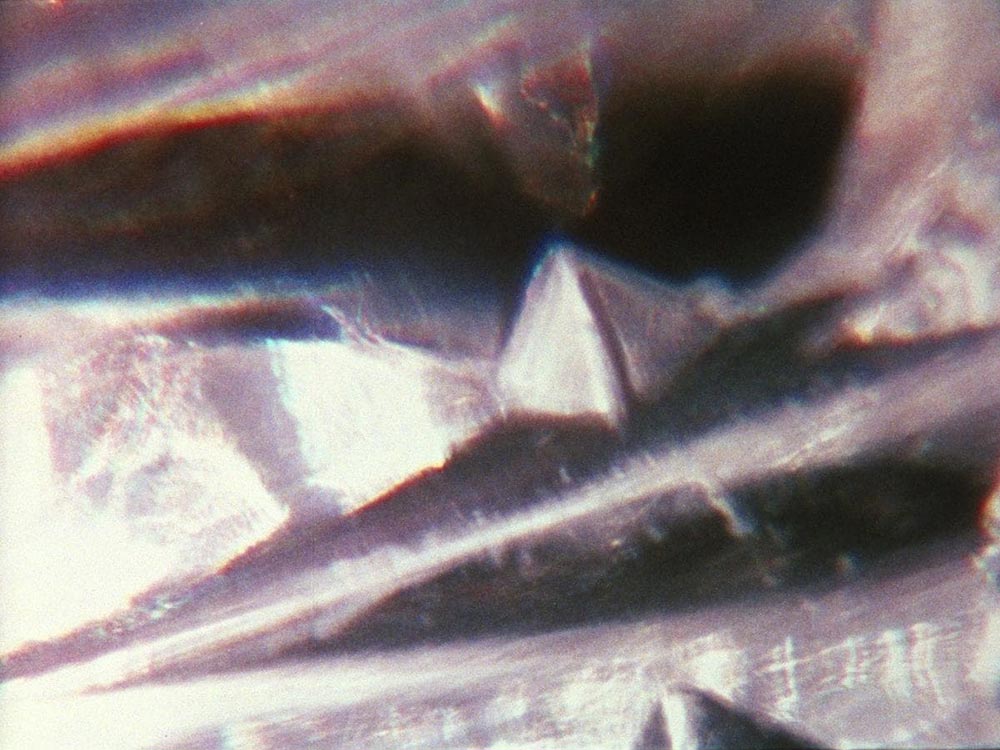
The lack of symmetry is not a negative element, but positivity itself; symmetry can offer no phenomenal flashes, no profound activity of the faculties. Thus, asymmetry affirms the marks by affirming the differences between them; for normally our eyes would not stop to see each one of them as they are.
Deleuze points out two types of repetition: static repetition, in which a plurality is reducible to a single concept, in this case the common space between all the dots in the top set. Thus for this type of repetition there is no internal difference. We might see every dot or hear every tick of the clock, yet they are no more than one same interval between one same redundant form. By contrast, dynamic repetition contains an internal repetition of a difference carried over from point to point, thereby making each instance distinct from the others. In this latter type, there is no unifying concept as there was with the repeating interval in the first group; it is a “pure dynamism” that never stagnates in sameness.
Deleuze makes another distinction between arithmetic symmetry based on ratios or simple fractions and geometrical symmetry based on proportions or irrational ratios, such as the golden ratio or pi. Such ratios are irrational surds, because they cannot be represented as one integer divided by another; there is always a remainder no matter how precise the calculation (as in the case of the unending sequence of decimals for pi: 3.14159265…). When such a ratio between two values is irrational, the two are considered incommensurable with each other, because they share no measure in common. (Thus the ratio of a circle’s circumference to its diameter is irrational for these two parts of the circle are incommensurable).
Deleuze speaks of surds in another, broader way:
| God makes the world by calculating, but his calculations never work out exactly, and it’s this inexactitude [injustice] in the result, this irreducible inequality, forms the condition of the world. The world “happens” while God calculates; if the calculation were exact, there would be no world. The world can be regarded as a “remainder,” and the real in the world understood in terms of fractional or even incommensurable numbers. | Dieu fait le monde en calculant, mais ses calculs ne tombent jamais juste, et c’est cette injustice dans le résultat, cette irréductible inégalité qui forme la condition du monde. Le monde «se fait» pendant que Dieu calcule ; il n’y aurait pas de monde si le calcul était juste. Le monde est toujours assimilable à un «reste», et le réel dans le monde ne peut être pensé qu’en termes de nombres fractionnaires ou même incommensurables. |
Deleuze further describes the static arithmetic symmetry as being rectilinear, and the dynamic as pentagonal and appearing in a “spiral line or in a geometrically progressing pulsation,” invoking Matila C. Ghyka’s examination of the golden ratio in Le Nombre d’Or, where Ghyka points out that the internal point where the golden spiral aims can never be determined. Instead we can only carry out the repetition of the ratio over and over again, each time making a smaller box and a more precisely tipped spiral, never arriving upon a determinate point. Each new extension terminates with some space remaining between it and the theoretical balance point, and can thus always be made more precise.
Deleuze’s purpose for distinguishing these two types of geometrical forms is to explain how certain arrangements of lines do not normally create visual rhythms (e.g. squares) and others do (e.g. pentagons), because the line angles of different shapes cause our eyes to move in different ways. A square grid lacks rhythm, because each point directs our eyes to another point in homogeneous distribution. However, some arrangements of shapes move our eyes in less orderly ways, and in some cases have a built-in infinity of possible non-redundant movements.
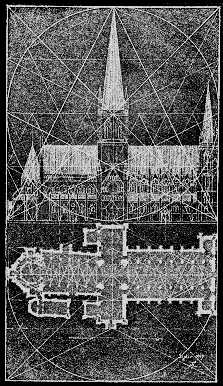
(I won’t belabor the point — who, me? — but Deleuze points to Gothic cathedrals as an example of geometry dictating the movement of the eye. Louis Andriessen drew on the architectural ratios guiding Gothic construction in writing his opera — you guessed it — Hadewijch.)
Klee called it chaos; Cézanne, the abyss. For Klee, the painter begins lost within a landscape, without a reference system of orienting points. Both Deleuze and Henri Maldiney emphasize the “iridescent chaos” Cézanne said enveloped him before painting. From this abyss the earth rises while the world obtains a measure of organization, but before long it caves in, collapsing back into a catastrophe: “a cataclysm has carried it all away, regenerated it,” according to Cézanne. The first response to it is vertigo. Citing Klee’s notebooks, Maldiney then explains how the cosmos comes to be generated: through rhythm, allowing for the incommensurable chaos to pass into an equalizing order; as Deleuze says, we organize a “rhythm in chaos.” For Deleuze, none other than Brakhage embodied the creation of order from chaos, calling attention to the filmmaker’s “Cézannian world before man, a dawn of ourselves, by filming all the shades of green seen by a baby in the prairie.”
For Brakhage, rhythm came in the form of the 24 frames per second projected by film. For Klee, rhythm emerged when the artist separated hues and tones, arranging them into relationships which maintain the endless movement of chaos, only in this case the motion travels between more determinate zones demarcated within the canvas. Too much order gives rise to stasis, devoid of movement or rhythm. Too much movement, conversely — so much that the colors and tones mix back to gray — then all that remains is a world colored gray, a world of nothing.
For Ashbery, the influence of chance, Klee’s chaos or Cézanne’s abyss — “this otherness / That gets included” — on the aesthetic process in Parmigianino’s portrait distorts not only the artist’s self-thwarting pursuit, “not just artistic creation,” but the very contour of life as well, “tearing the matter / Of creation, any creation… out of our hands.” It compels an awareness of contingency so basic to the passage of time, “Forms of daily activity, changing everything / Slightly and profoundly,” that the poet cannot but count it in, violently, among the painter’s resolutions. Even unforeseen distractions infiltrate Parmigianino’s original purpose, proving too immediate in their temptation to resist and too unpredictable to control:
Seduced by flowers,
Explicit pleasures, he blames himself (though
Secretly satisfied with the result)
As readers, we share in the painter’s humiliation, since “This otherness, this / Not-being-us” overwhelms our own interpretation of the portrait’s “smooth, perhaps even bland (but so / Enigmatic) finish.” To borrow a phrase from David Shapiro’s description of this common difficulty: it “reminds us of the foolishness of any facile choice.” Without knowing how or why, we realize necessity bypasses any closed scheme of ends, that though it compromises the conditions for the poet’s (and our own) lyrical intimacy with the painter, it “is all there is to look at / In the mirror.”
Once it seemed so perfect — gloss on the fine
Freckled skin, lips moistened as though about to part
Releasing speech, and the familiar look
Of clothes and furniture that one forgets.
The last strophe of the poem anatomizes the loss bound up with the self-portrait’s constricting image of Parmigianino’s life. Ashbery reflects on the relativity of any interpretation of the painting, alerting the reader that the painter (like the poet himself), though the author of his self-portrait, is neither the pre-existing subject of his work (or text) nor the sole foundation of the poem’s language, which ceaselessly refuses to confer an origin. He includes the reader’s impressions of the portrait as integral parts of its otherwise limited content and subverts the role of the painter as the centerpiece of his work, the dominant “face” of his portrayal:
This past
Is now here: the painter’s
Reflected face, in which we linger, receiving
Dreams and inspirations on an unassigned
Frequency
For the poet, any totalizing, self-contained rendition of the painter’s life is insufficient:
Each person
Has one big theory to explain the universe
but it doesn’t tell the whole story
And even when he does affirm the painter’s particularity and voice, his language takes on the tone of irrecoverable opportunity.
Therefore I beseech you, withdraw that hand,
Offer it no longer as shield or greeting,
The shield of a greeting, Francesco:
There is room for one bullet in the chamber:
Our looking through the wrong end
Of the telescope as you fall back at a speed
Faster than that of light to flatten ultimately
Among the features of the room
“Releasing speech” is a fitting emblem for the kind of satisfaction sought and suppressed within the language of this poem, which is always also a lost paradise. But as readers, what personal insights can we obtain from it? For one, Ashbery reconsiders Parmigianino’s presentation of “releasing speech” as the discourse of a single subject. He resists the self-portrait’s arrangement of visual elements into a fixed representation of a life and embraces pluralism. It is also precisely because the creative impulse behind each artwork is unpredictable and “distorts” the artist’s initial motivation, that its moral paraphrase — whether by the poet or the reader — must itself become an act of individuation. Mere imitation is not enough to transcend the limits imposed by conventions: “Aping naturalness… is the first step only.” For this so-called “self-consuming text,” true emancipation involves a radical transition from intimate colloquy with the painter to the announcement of a death wish.
(In my reading, a “self-consuming text” is one that does not corroborate the author’s purported “message” or “moral,” and so is unable to prescribe truth through art. For more on this, see Stanley E. Fish’s Self-Consuming Artifacts: The Experience of Seventeenth-Century Literature.)
The poet’s plea revises the initial, ambivalent description of the painter’s creative hand as both a mediating link and obstacle interposed between them:
thrust at the viewer
And swerving easily away, as though to protect
What it advertises.
Here, the gesture serves as an explicit appeal to disarm the impression of a life embalmed in the portrait — “the shield of a greeting” abandoning all pretense of conveying the whole truth about Parmigianino’s past. Ashbery collapses the convex perspective (“the wrong end / Of the telescope”) into realism and discloses the core lifelessness of the painter’s image.
To preserve himself, the poet resigns his visionary sympathy towards the illusory figure, “Francesco: / There is room for one bullet in the chamber.” The broken bond renounces a shared aesthetic aim, prompting a recognition of the absences implicit in Parmigianino’s totalizing portrait:
the “it was all a dream”
Syndrome, though the “all” tells tersely
Enough how it wasn’t.
In acknowledging life beyond the all-reductive surface, Ashbery energizes his own text by giving precedence to the multiple references, ruminations, and displacements of his poetry; not as a way of giving an impossible form to the temporal world, but in the humble awareness that the only “content” of expression is “Here and there, in cold pockets / Of remembrance, whispers out of time.”
Anyway, I’m sure you’re asking yourself how any of this applies to a flickering experimental film. Will you catch the whispers out of time when you watch Strophisches Gedichten? Well, if you’re around London this weekend, you can find out for yourself…

Leave a Reply