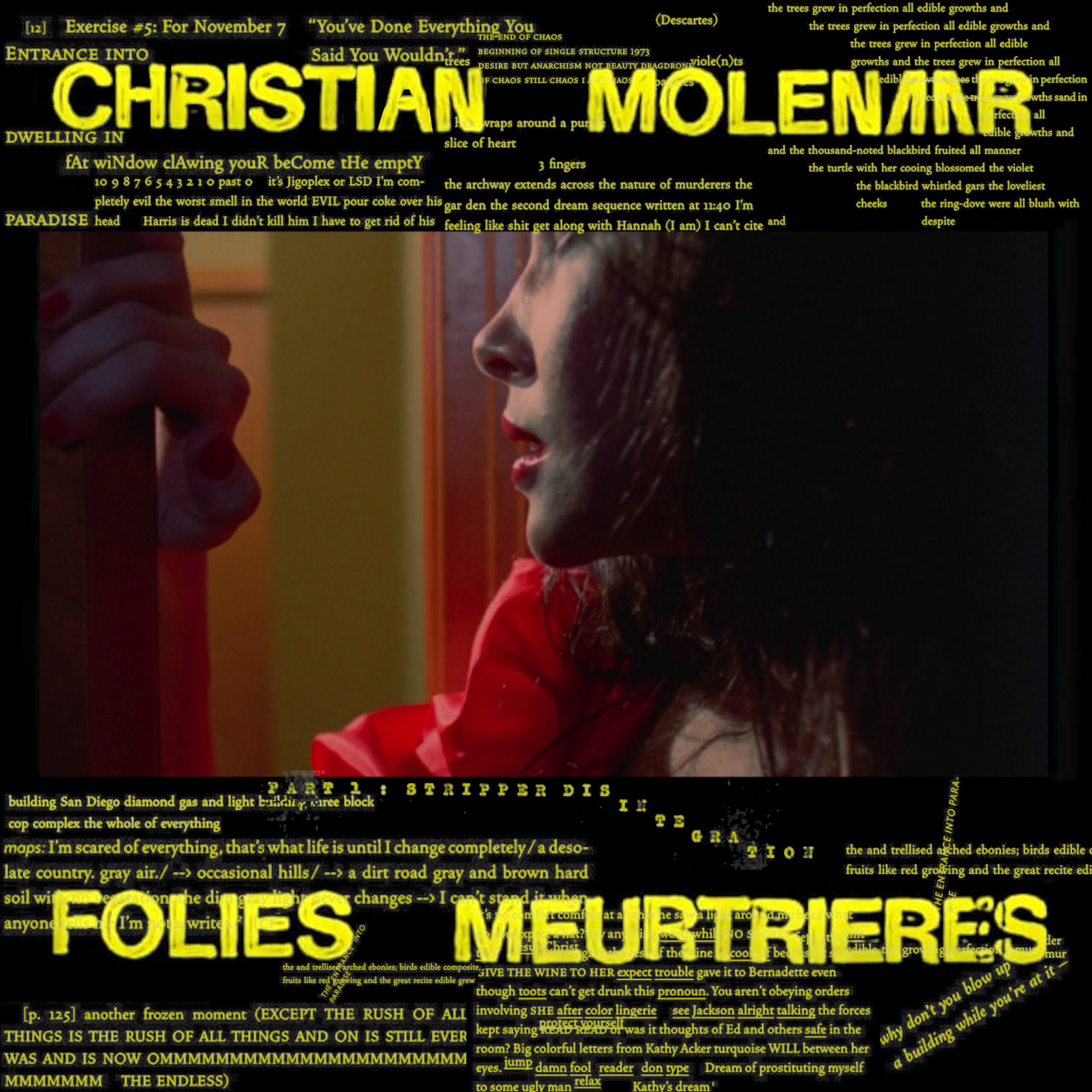
My new album Folies Meurtrières is out today.
A kind of hallucinated personal history of my beloved Bay Area, the record bounces between banjo-based black metal, prepared guitar reggaeton and lo-fi house remixes of the Jacksons. I’d like to declare this record a labor of love but sometimes it felt like I was laboring to finish it out of pure spite. I started writing around the first guitar tracks over a year ago with the intention of crafting a sequel of sorts to Laughlin Cantate, following a similar process of transforming my initial improvisations into finished songs. Over a year later, Folies Meurtrières has arrived.
(I wanted to release this album in October, for various reasons: the dark and spooky vibe, my anniversary with Hannah and simply the fact I finished mixing it then. In putting together the cover from Kathy Acker’s diaries I couldn’t help but comply with the November 7th date which appears in the top left portion of the art.)
I’ve told the story so many times it hardly bears repeating, but Laughlin Cantate was a necessary step for me in breaking through the walls of a depressive episode and returning me to artistic productivity. At the time, escaping that dark cloud, I felt Folies Meurtrières had the potential to be my finest work yet. A year later I’m not so sure it wasn’t all folly.
Anyone who’s walked San Francisco knows the city’s foundations were laid on a terrain of steep hills. In its early days the only way to conquer those inclines was by horse. Andrew Hallidie had arrived in San Francisco with his father to find gold, but by 1853, his father had returned home without success. Andrew stayed, working as a surveyor and bridge builder, and in three years he was being consulted over the rapid rate of wear on the ropes used to lower cars of rock from the mine to the mill. Hallidie improvised a replacement wire rope that lasted two years, and in the process began wire rope manufacture, which quickly prospered off demand from the Comstock silver mines. The development of wire cable led Hallidie to perfect the first cable car, which descended the Clay Street Hill at 5:00 in the morning on August 2nd, 1873, an hour chosen to avoid possible injury should the debut fail and the trolley plummet out of control. The gripman he hired peered down the steep slope from Jones and refused to operate the machinery, so Hallidie took the grip himself and negotiated the car smoothly down the hill and back up again without any problems. And so “Hallidie’s Folly” proved a success, one which would make Hallidie rich off his cable car patents design alone. I doubt the instrumental intro to this album will do the same for me, but I lifted the title for it from the Cable Car Museum anyway.
Midway through the track an electric piano appears in the form of a field recording of a busker at a BART station somewhere in Oakland. There’s not a lot of piano on this album, though the spirit of the keyboard haunts it in another way. Throughout the making of this record I kept returning to the writing of William Gaddis, for whom the player piano was a significant symbolic development, its history illuminating a great deal about the growth of binary thinking and what he saw as the epochal shift from artistic to entertainment values. In this way it lends itself perfectly to his several linked larger investigations, including the questioning of the authenticity and authority of artistic work (The Recognitions) and the warping force of capitalism (JR), especially in the cultural arena.
I’ve used samplers and synthesizers for as long as I’ve recorded music. With the recent proliferation of AI-generated music, I’ve tried to think more deeply about their place in my creative process, and the player piano makes for a tidy synecdoche. To quote Ralf Huter of Kraftwerk: “We play the machines, but the machines also play us. This we don’t deny like they do in conventional music. There the man is always considered superior to his machine, but this is not so. The machine should not only do slave work. We try to treat them as colleagues so they exchange energies with us.”
Gaddis’s views often recall those of Walter Benjamin weighing the loss of “aura” — the immediacy of the unique work of art — against the proclaimed gains of a democratic dissemination of reproductions. Of course Benjamin got there first, moreover mounting a sustained argument, whereas Gaddis’ treatment, either via Jack Gibbs, in his voluminous notes, or in his protagonist’s drug-inflected musings in Agapē Agape, was impressionistic at best. Perhaps that’s the best I can hope to achieve as well. Gaddis used his research to make what is ultimately an emotional argument about the decline of culture, the compromise of quality and uniqueness by lock-step standardization. Still, the serious intellectual grounding is there and his critique lends considerable power to this transcription of a dying man’s outcry, a literary model Gaddis borrowed from Bernhard’s Concrete.
No but you see I’ve got to explain all this because I don’t, we don’t know how much time there is left and I have to work on the, to finish this work of mine while I, why I’ve brought in this whole pile of books notes pages clippings and God knows what, get it all sorted and organized when I get this property divided up and the business and worries that go with it while they keep me here to be cut up and scraped and stapled and cut up again my damn leg look at it, layered with staples like that old suit of Japanese armour in the dining hall feel like I’m being dismantled piece by piece, houses, cottages, stables orchards and all the damn decisions and distractions I’ve got the papers land surveys deeds and all of it right in this heap somewhere, get it cleared up and settled before everything collapses and it’s all swallowed up by lawyers and taxes like everything else because that’s what it’s about, that’s what my work is about, the collapse of everything, of meaning, of values, of art, disorder and dislocation wherever you look, entropy drowning everything in sight, entertainment and technology and every four year old with a computer, everybody his own artist where the whole thing came from, the binary system and the computer where technology came from in the first place, you see?
That’s the first sentence of Agapē Agape, Gaddis’s final, posthumously-published novel, written before his death by prostate cancer in 1998. Gaddis plunges us straightaway into the mind of a dying man. It is, on that level, mimetic. It is also complexly calculated. Aside from the obvious debt to the stream-of-consciousness strains of modernism (Joyce and Woolf), we can point to the click-and-rewind line disruptions of Beckett, most obviously in Krapp’s Last Tape, and the staggered syncopations of the player piano itself, or perhaps of Glenn Gould, who haunts both Gaddis’s novel as well as Bernhard’s The Loser, imposing his peculiar discipline on the idea of the melodic, though of course the true root influence remains Bernhard’s Concrete.

The first real song on the album, “Spellevexit,” takes its name from Alexander Theroux’s Darconville’s Cat. The song was an attempt to write a Bad Bunny-esque slice of reggaeton, albeit one played on prepared guitar over a percussion track algorithmically generated in Pure Data. One of my primary goals in conceptualizing this album was to take my guitar-based improvisations and force them into new contexts, away from the folk songs to which they seemed naturally to lend themselves. To that end I revisited many of my favorite 90s and 2000s r&b albums for the way they incorporate classical guitars, harps and other plucked strings (or samples thereof) in crafting unique musical settings. I still ended up writing one or two folk songs, but 80% isn’t too bad a record.
February 11, 2024 saw the conjunction of Hannah’s birthday and Super Bowl LVIII featuring the 49ers facing off against the Chiefs. Chinese New Year had fallen on the night before, so obviously the city of San Francisco set aside the entire weekend to party, and the streets ran red with flags and jerseys. Waymo’s fleet of self-driving Jaguars patrolled every corner. We were taking the bus back from the Mission towards North Beach and passing Chinatown were assaulted by what we first assumed to be gunfire but was merely a volley of fireworks sparking off the side of our bus. Later in the night someone would set off fireworks inside a Waymo. Obeying its directives to avoid blocking emergency vehicles, the flaming car burned down every one of Chinatown’s narrow alleyways attempting to shake off the pursuing fire trucks.
We were at the club half-watching the game on the TVs behind the stage as the 49ers led for the first three quarters before the Chiefs rallied at the very end. Our dancer friends all wore red until the game was finally called, at which point they retired to the dressing room to change into black to properly mourn their team. I couldn’t help but see in them the nobility in defeat of Rodin’s Burghers of Calais; Melville’s Confidence-Man was my vacation read on the trip, and somehow his reference to Spenser’s Shepheardes Calender in chapter one leapt to mind, along with a line from Maggie Nelson’s poem “Carnegie Hall”:
Red-coated ushers swim
in a sea of silk saris
Usher me in, gentlemen
Raw silk the colors of arteries
I borrowed the title “Last Flag Flying” from Richard Linklater’s sequel to The Last Detail, neither of which films I particularly like (I’ll stick to On the Town) but felt fitting for the theme of wounded pride and nobility in defeat.
Of all the songs on this album “Morning Song” stands out to me as the strongest and one of my favorites I’ve ever written. It might be the closest I’ve thus far come to a certain ideal of songwriting I hold, embodied most clearly in the music of Joni Mitchell, Judee Sill or Prince. It’s a music which privileges a certain elegance of melody and artfulness of phrase; maybe one day I’ll find the time to write out whatever it is I mean. Lyrically, the song relates the story of Bob, who lost his leg after falling from a cliff while rock climbing in Colorado. If you ask me in person I’ll tell you about his tattoo.

In many nineteenth century views of San Francisco a strange castle looms over Telegraph Hill where Coit Tower stands today. A restaurant, bar, and observatory, the landmark went under many names: the Telegraph Hill Observatory, the Pioneer Park Observatory, the German Castle, Layman’s Castle, and perhaps most accurately, “Layman’s Folly.”
Following Andrew Hallidie’s example, Frederick O. Layman wanted to create a cable car line up Telegraph Hill and open up the steep hillside to development in the way the Clay, Sutter, and California Street cable cars had made Nob Hill the home of the city’s fashionable elite over the 1870s. He applied to the city for a franchise running on Kearny Street from downtown up the south slope of Telegraph Hill, and was given permission by the Board of Supervisors and mayor in May 1882. Layman knew the potential nabobs and their mansions would take time to attract, however, and the few occupants of the humble cottages that clung to dirt paths on the hill certainly wouldn’t provide enough fares for instant profits. Needing investors for his new transit company and income on the books right away, Layman came up with an attraction to attract future ridership and build buzz behind his cable car company.
It wasn’t an original idea. Today’s Geary Boulevard in the Richmond started as a toll road in 1863, opening in tandem with the Cliff House. Day-trippers paid a toll to use the road and paid again at the Cliff House for refreshments. Layman’s own destination of hospitality began as a one-story structure with a crenelated roofline and tiny towers — a mini-castle — and opened for business on July 4, 1882. With no cable car line yet, visitors had to hike their way up for drinks, band music, and views of the bay.
The transit company, meanwhile, got off to a poor start: Kearny Street proved too narrow for his planned cable line infrastructure and the street’s residents were less than welcoming to the idea. Layman changed course and applied for a new franchise up the west side of the hill on Greenwich Street, intent on connecting Telegraph Hill with Russian Hill through a cable line from Leavenworth Street all the way over the summit, past the castle, and down the steep east side to the Embarcadero. The city approved for the franchise in November 1882. Take a moment to appreciate how expediently business and government cooperated in Gilded Age San Francisco: Layman received approval for one cable car franchise in May 1882, built a bar and restaurant on the summit which opened July 4, then applied for and was granted a different cable car franchise by the city in November.
Over 1883, Layman raised enough money to begin construction on part of his Greenwich Street line. In preparation for the opening, Layman enlarged the castle observatory into a rambling four-story folly with additional verandas, false turrets, and a west-facing tower.
On June 29, 1884, the Telegraph Hill Railroad was officially dedicated with a massive gala at the observatory. Unfortunately for Layman, the Greenwich cable line was a failure from the start. Only a section between Powell Street and the summit was ever built, and without a direct link to downtown — one had to transfer to a different company’s line — there was never enough patronage for it to pay. Service ended in less than two years. The empty hulk of a castle roadhouse remained, stranded at the top of the hill. The view quickly wore out as a novelty and fewer visitors found reason to make the climb to what was now called “Layman’s Folly.”

“Darconville’s Alarm Clock” riffs most obviously on Theroux, Buckethead, and Clark Coolidge’s “Arc of His Slow Demeanors.” Coolidge once called an early book of his poetry the product of “a time of fascination with word-fragmentation, building from syllabic plucks, particularly the ends of words.” One of the key inspirations writing this album was Meshuggah’s combination of machinelike rhythms with Fredrik Thordendal’s expressive, alien soloing; this track is the only one to make that influence explicit, namely with a repeated reference to “Dancers to a Discordant System” off ObZen.
William T. Vollmann’s chronicles of San Francisco’s underbelly provided the inspiration for “Butterfly Tenderloin,” which also folds King Crimson and (once more) Judee Sill into mix.
“Whatever!!” incorporates the first of two major Beethoven references on the album in the form of a callback to his B♭ quartet, Op. 130, namely to the cavatina which forms the quartet’s penultimate movement and which according to his secretary, violinist Karl Holz, Beethoven said he wrote “truly in the tears of melancholy” and “never had his own music made such an impression on him.” The cavatina has always struck a chord in me and felt natural to include while improvising on the cello, albeit warped and distorted through 11-limit Heimholtz-Ellis Just Intonation. (I was partially inspired here by Adam Kalmbach’s microtonal extension Brahms for Jute Gyte’s “Like the Woodcutter Sawing His Hands,” of which he’s said “it’s not easy (or necessary) to hear the source in the final arrangement.” I doubt anyone listening to my song will hear either Beethoven or Jute Gyte, but then little I do could be called easy (or necessary).) I played this song at the Brown Building back in January where Amy told me it sounded like Arthur Russell, a comparison I’ll gladly take any day.
“(Bear Trap) Lost Youth” began as a remix of another performer on the BART, this time a rapper walking a full PA from train car to train car trying to garner followers on Instagram. I was going for a Ross from Friends-style lo-fi house sound. Every other time I listen to this track I either find it somewhat successful in accomplishing what I set out to do or an utter failure, a synecdoche of my feelings toward the album as a whole and maybe my entire artistic oeuvre.
“Beach Blanket Babylon Blvd.” features the second Beethoven shoutout on the album, this time his Op. 59, No. 1, the first of the three “Rasumovsky” quartets. On one of our first trips to the Bay, Hannah and I were lucky enough to see the San Francisco Civic Music Association play the quartet (alongside flute quartets by Marc Berthomieu and my longtime favorite Eugène Bozza) at the Noe Valley Ministry.
As ever when I release an album under my own name, I’ve labored over its contents for long enough I find it difficult to gauge my own response to it. Every other time I relisten to this record I vacillate between finding it a moderate success despite its flaws or zeroing in exclusively on those same issues. Of course, I felt the same about Laughlin Cantate and every Those Darn Gnomes record but eventually they all grow on me. Whether or not Folies Meurtrières will garner the same warm reception from me remains to be seen, but in the meantime I once again have a new album in the works I consider to be my finest to date, across any of my various projects. As always, watch this space (or remain blissfully ignorant)…

Leave a Reply