I’ve just watched Daniel Schmid’s La Paloma which has almost immediately joined the ranks of my personal canon.
For his second feature, Schmid reunites with almost the entire cast of Fassbinder acolytes with whom he worked on his first film, Heute nacht oder nie, this time adapting one of RWF’s own plays. Prior to making this film, Schmid had appeared in both Fassbinder’s Händler der vier Jahreszeiten and Syberberg’s Ludwig – Requiem für einen jungfräulichen König, which should provide one with the basic idea of the look here. The first 15 minutes or so of this casino-set Romantic fable unfold without any dialogue, the only words delivered through abstractly staged musical numbers, and the best moments throughout the film always arrive outside of conversation (which is not to diminish Ingrid Caven’s excellent deadpan address to the camera).
La Paloma more or less adapts La Dame aux Camélias, but Fassbinder must already have been having some fun with Sternberg’s Blue Angel archetype in crafting the character of Viola. But if Sternberg’s influence makes itself apparent anywhere in Schmid’s film, it’s the late style of The Shanghai Gesture, by which point Sternberg had completely divested himself of real-world referents in which to ground his plots, and nearly of plot altogether: like that film, La Paloma has seemingly no interest in how or why Isidor rescues Viola from her low-class surroundings and terminal illness. Instead, Schmid focuses, India Song-like, on the aesthetic trappings of his aristocratic world, his idle train rides across the European countryside, crystal decanters on pristine tablecloths, castles decorated with overripe flowers. I don’t mean to keep invoking other filmmakers, but Ophüls makes for another obvious touchstone, and I’m particularly reminded of what Victor Perkins zeroed in on in his review of Lola Montès, “what is morbid in our Romantic inheritance…”
Coming up in the European art cinema of the 70s and working with iconoclasts like the aforementioned Syberberg, Schmid’s own relationship to his Romantic lineage seems to have remained productively thorny, pushing him to pursue gorgeous aesthetics which he took every opportunity to deflate and dissect. This aspect puts him in natural alignment with another collaborator, Werner Schroeter, who praised La Paloma as a “triumph of kitsch” before pointing out Schmid’s ability to take “these elements [and] transform [them] into something new, which not only has ironic distance but also surmounts this distance again, in a kind of somersault, thereby attaining new expressive force.” Gary Indiana wrote a fawning review of La Paloma (“…a story every human person lives at least once” — speak for yourself, queen!) in which he calls the legacy of Romanticism “a souvenir of the last century, and not the worst one.” If all Romanticism is ultimately fatal, La Paloma‘s guignol ending offers a darkly hilarious illustration, turning our collective souvenir of the 19th century into a beautifully sculpted cenotaph.

Side note: I watched the above VHS rip of this on YouTube which turns the whole thing into a gooey, indistinct mess — and if you know me you know that’s not a complaint — but apparently I just missed the new 4k restoration playing in LA in March! I’ll definitely be keeping an eye out for a future screening.
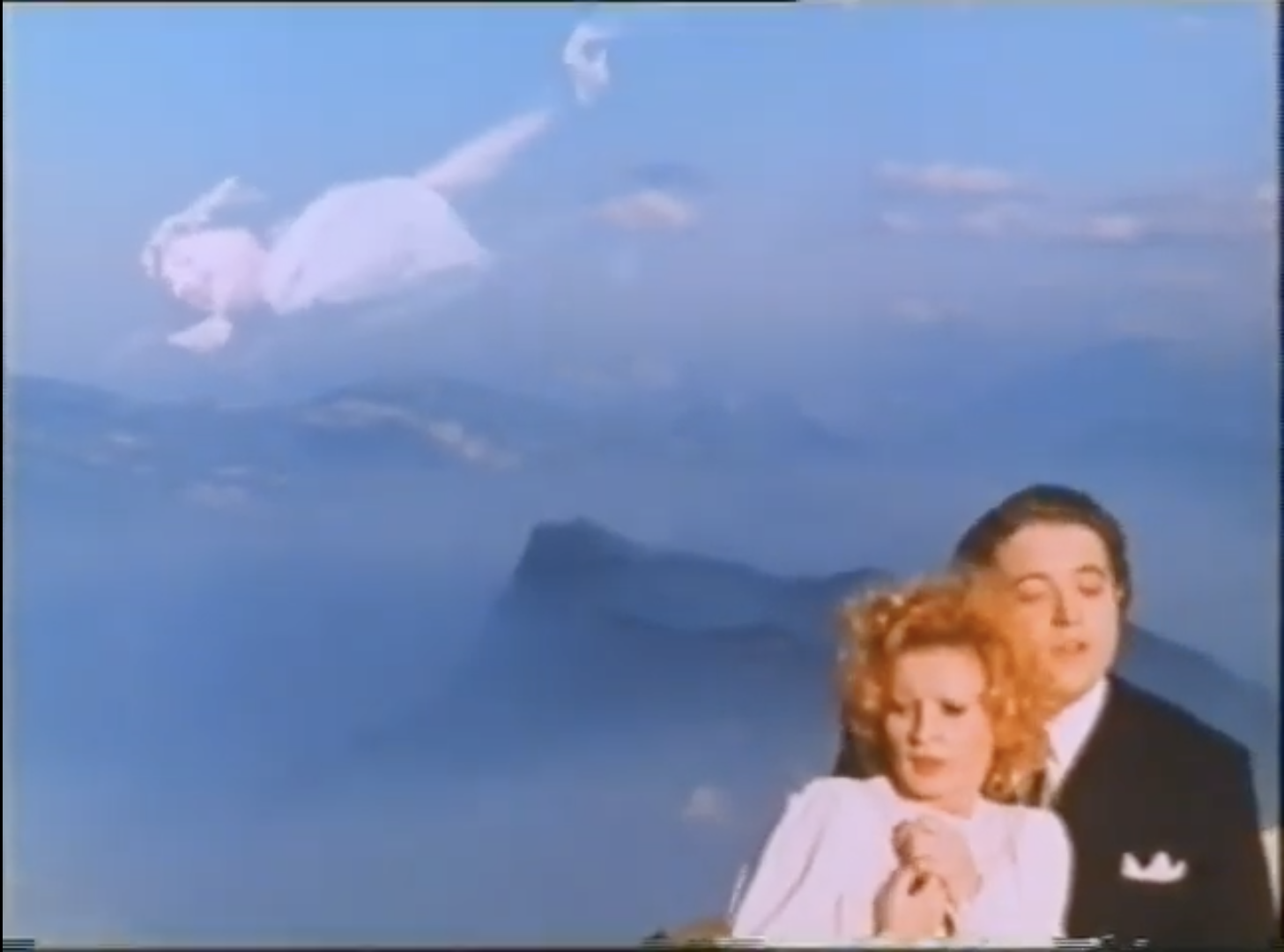
The topmost image on this post comes a scenes in which Ingrid Caven and Peter Kern lip sync an operatic duet in front of a Romantic landscape. After a few minutes, a spectral figure floats into the top left portion of the frame in a composition reminiscent of Chagall’s paintings of flying couples.

In 1918’s Over the Town, Chagall and his wife Bella Rosenfeld soar over Chagall’s native Vitebsk. “I suddenly felt as if we were taking off,” Rosenfeld would later say of the moment they became engaged, and Chagall’s painting offers no question of as if. “You too were poised on one leg, as if the little room could no longer contain you. You soar up to the ceiling. Your head turned down to me, and turned mine up to you… We flew over fields of flowers, shuttered houses, roofs, yards, churches.”

The Promenade, painted a year prior in the immediate wake of the October Revolution, illustrates Chagall’s newfound zest for living which arose in tandem with a new phase of artistic accomplishment. To that must be added the political atmosphere, the exhilarating sense of freedom and optimism generated by the Revolution. For Jews the revolution meant true liberation; at last they were entitled to the same full rights as every other citizen of the state. Humiliations such as the young Chagall had experienced during his studies in St. Petersburg, where Jews were allowed to stay only by permit, were now out of the question. Additionally, the avant-garde to which Chagall belonged had everything to gain from the revolutionary sweep. Bella’s presence in his life added a further glow of optimism to Chagall’s worldview despite the many adverse circumstances of the outside world.
So these large-scale pictures indicate a high-spirited, even exultant attitude to life, and they all center on Bella, against the background of the home town. In The Promenade Bella in ecstatic jubilation flutters like a flag in the wind, held up in the sky on the arm of Chagall, who laughs with joyful abandon in his best clothes.
This ecstasy is in accord with the expansive decorative character of the picture. The dancing double figure extends over the plane like an ornamental emblem. The precious ornamentation of Bella’s skirt pleats, as in a Futurist rendering of movement, emphasizes the swinging effect of her floating figure. Chagall continues the ornamental stratification of form through the entire composition, arranging the meadow into a geometrical pattern, grouping the medley of cubic houses, reaching up into the sky in a variety of transparent geometrical forms, and culminating in the exuberantly patterned picnic cloth, which appears purely as a surface ornament. Every lesson Chagall learned from Cubism and Futurism — together with those from Henri Matisse — have clearly gone into the making of the picture, but they are used to bring about a closer description of reality, even if the style is a little in the manner of poster art.
One more: my in-laws were married in Paris and they keep a print of 1939’s The Bridal Pair with The Eiffel Tower in their bedroom, which I just find extremely sweet. Throw a beard on the groom and you’d have Anne and Steve:


Leave a Reply