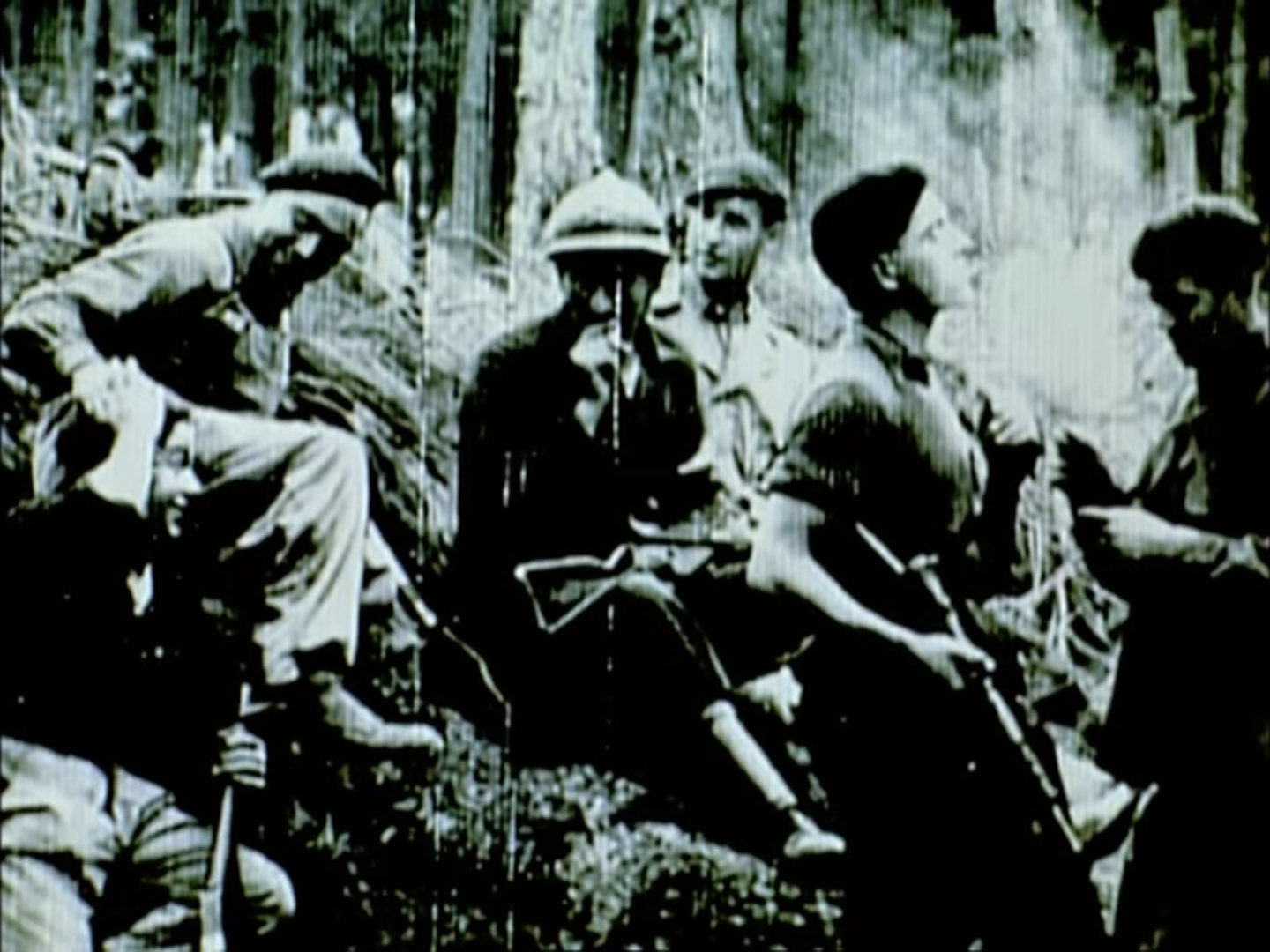
As Péguy said on June 17, 1940: “In war, I side with he who won’t surrender the citadel.”
Sure. Catholics and the Resistance. But right now I’m doing background research. I’m writing a cantata for Simone Weil. You know what she said about the Bible? That it wasn’t a theory about God but a theory about Man.
Do you think the people in London pondered those things?


After watching Éloge de l’amour a couple months ago I called it Godard’s Collateral, a late style riff applying his oblique aesthetique techniques to a relatively contained story told almost entirely in nocturnal driving sequences. A movie that really reminds you these are whole lives going on behind the scenes, and like Mann, Godard can’t help himself from gesturing at structural etiologies even when he’s working within a restricted narrative framework. And despite appearances, Éloge de l’amour is probably the most plot-reliant film Godard made in this century — which, y’know, isn’t a crazy high bar, but when they call this one a riff on Le Mépris it’s not for nothing! One of those ultra-late auteur pieces like Inland Empire or Megalopolis or Agapē Agape which could only be the end product of a lifetime of engagement with the medium in all its successes and failures. I promise I’m not blind to the irony of labeling a Godard film in particular an “end product” given not only his own history of exposing the inner workings of film financing, onscreen and off, but also because few filmmakers (Brakhage among them) treated the entire production and exhibition of film as the “product” of subject-object relationships: first as camera contra eye (Godard in the Éloge de l’amour press book: “The problem is that directors take a camera but they put themselves in the camera’s place. The camera needs its independence.”), eventually screen contra viewer. “Art” is the Bataillean surplus of a productive relation between creator and medium, creator and audience, etc. Not a Badiou guy but when he calls an encounter something that “happens to you that nothing among your existing world’s points of reference made likely or necessary” it’s the same idea:
For it to be a genuine encounter, we must always be able to assume that it is the beginning of a possible adventure. You cannot demand an insurance contract with whomever it is that you have encountered. Since the encounter is incalculable, if you try to reduce this insecurity then you destroy the encounter itself, that is to say, accepting someone entering into your life as a complete person.
Did anyone besides Godard so fully embody the creation of a film as a complete person? “The real reverse shot hasn’t been found,” he wrote again in the Éloge de l’amour press book. “The director no longer tries to have two people look at each other, listen to each other, think of each other, which is already six possibilities multiplied by six, which amounts to years of film!” And years of film — a lifetime, in fact — compressed into 90 minutes is exactly what Godard offers his viewers, spilling forth not only his momentary fancies but obsessions that dogged him since his Cahiers days. Godard was one of film’s first true modernists, an artist with the camera who devoted his life to deconstructing and questioning what these sequenced images we watch projected on a screen materially do. His best films (and this ranks easily among them) offer a rich surface text for engagement on its own merits, but the full weight only arrives extra-textually once the viewer can internalize it as one in a series of iterations working toward a certain goal, like Cy Twombly’s paintings or Budd Boetticher’s westerns. “There must be some disposition towards openness, thus a fundamental relation of confidence,” Badiou says. “And moreover, bizarrely, a passive faculty, a sort of virtue — to use an old-fashioned word — the virtue of accepting that something is happening that you had not foreseen.” In my own life I’ve been trying to pursue collaborative art-making as an agglomeration of personalities chasing a collectivized goal, with the art itself not the plastic medium in which we’re working but the productive relations between players. (kinda sorta alluded to this here) Maybe I really am a Badiou guy:
…the artistic encounter is the hold that some type of organized imaginary exerts on you. But the common element is always this feeling that ‘this is happening to you.’ A novel that changes you, is something that you have to deal with, even if later your taste changes and you ask yourself ‘why did I like this book when I was younger?’, exactly as Proust’s hero asks himself why he loved a woman who ‘wasn’t his type’…
And of course not only does the work of art change you, but you change the work of art as your interpretive framework grows and develops with you over the course of a life. So despite Godard’s complaint to the contrary (“You can show your worth in a first film, because you have 15 to 20 years of life behind you. Later, for the second film, you only have a year behind you. You can’t show your worth.”), when he returns to Le Mépris in the 80s we get Grandeur et décadence d’un petit commerce de cinéma; in the 90s, For Ever Mozart; the 2000s, Éloge de l’amour. So much for only a year behind him; with each subsequent film Godard diagnoses and defines what it means to make images in their respective decades. Hopefully we get his descendant today who can interrogate our own historical moment, populated such as it is with either images of genocide or else ones generated entirely away from reality.


Leave a Reply